Room 237
Filmmaker Rodney Ascher’s 2012 documentary Room 237 follows a several interpretations and conspiracy theories following director Stanley Kubrick’s 1980 adaptation of Stephen King’s novel The Shining. From genocide of Indians, the Holocaust, and the moon landing, this film analyzes the vast number of “clues” denoted by Kubrick during the film’s production. Never showing the interviewees, Ascher focuses on a variety of people and their interpretations of what Kubrick intended in his adaptation. Ascher’s goal is not to present these accusations as truth, but rather demonstrate multiple theories that fans of The Shining can respond to. The documentary is not necessarily from the perspective of Ascher. He is the interviewer collecting various opinions and conspiracy from others who have studied the film. His objective is to show how many notions surround the film, some seeming relatively reasonable and others just downright insane. For instance, one interviewee claims that the government staged the moon landing with Kubrick filming it, and The Shining was Kubrick admitting his role through the changes he made from the original novel. In modern days, a majority of people believes the moon landing footage was genuine, and this theory seems ridiculous. However, the interviewee supports his thinking with examples from the film. Though he backs up his belief, it is not enough to sway a public opinion that has been grounded for over four decades. Ascher simply records these people’s findings and assembles them as a collection of conspiracies. His role is justified by his indifference toward analysis; he seems the film as “a story about juggling the responsibilities of your career and family and as cautionary tale of what may happen if you make the wrong choice” (http://www.complex.com/pop-culture/2013/03/interview-room-237-director-rodney-aschersource). Rather than having a strong, set opinion of The Shining’s hidden messages, his unconcern allows him to collect these theories without letting his personal interpretations get in the way, dismissing all these conspiracies. Instead of developing his own voice for the film, he allows the variety of opinions to mold a cohesive narrative of a film that is open to various analyses. In that regard Ascher holds the utmost power below Kubrick himself who is the only one to know his true intentions.
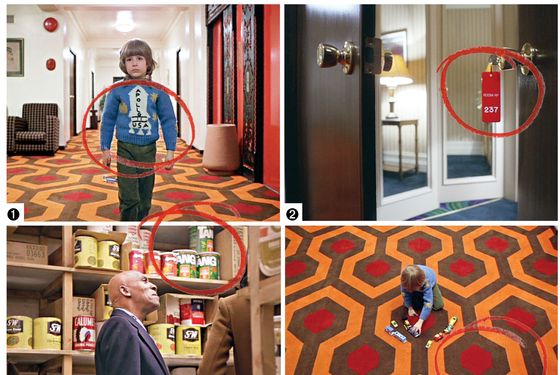
This picture circles some of the topics of conspiracy mentioned in the documentary such as Danny's Apollo 11 sweater and the cans of Calumet baking powder displaying a Native American man in a headdress.

No comments:
Post a Comment