Lost Souls from Kevin Wegener on Vimeo.
My final project.Thursday, December 5, 2013

RADIO (Voice)
Radiolab: Famous Tumors
When they first start discussing
Ulysses S. Grant and his tumor, a flutelike instrument starts playing in a
haunting Dark Shadows kind of way.
This sets the mood for this kind of grim, mystical topic. However, once they
explain it more and walk through the process of viewing the tumor, it seems
less creepy and supernatural. Later when they start talking about Tasmania and
describe the rocky, desert landscape often associated with Australia and that
corner of the world, Indiana Jones-type
adventure music is playing, but once he starts explaining this other part that
is more green with scenery, the music shifts to a more romanticized classic
Hollywood soundtrack. Throughout the broadcast, they use similar effects to
these examples displaying an eerie tone surrounding the uninviting, microscopic
subject matter of a tumor. The music really helps to set the tone. It can
change the mood of the situation with different tempos and lighter or darker
melodies that control an environment. Since we are so often focused on imagery,
we often forget the impact that sound can have on a piece. Radio really
demonstrates that since it relies entirely on sound with no visual aid. As the
song says, video killed the radio star, but perhaps it’s not a dead medium.
People still listen to radio in the car on their way to work. Some listen to
podcasts discussing varying subject matter. Other people still use radio as a
primary form of entertainment. However you listen to radio, we live in an ever
changing world, and a majority of people in the United States have access to
podcasts and radio sitting in their pockets. People often forget the true
importance of sound until it is not there. Sounds and music can completely sway
a scene without the audience even noticing. Radio then becomes even more
impressive considering it needs to convey a message without any aid apart from
voice and sounds. Especially when you actually end up doing projects with
sound, and realize how important it truly is and how we take it for granted.
NARRATIVE (Representation)
Edward Scissorhands
In his 1990 classic Edward Scissorhands director Tim Burton
explores the idea of being an outsider in a very unique way. Presented as a
fairytale with his classic aesthetic, Burton channels memories from his
adolescence to show what it feels to be different. Throughout the film the
title character struggles to live in a slightly exaggerated suburbia and proves
the age-old expression that looks can be deceiving. While Edward may look like
a monster with pale, scarred skin, gothic apparel, and dangerous scissors for
hands, he reveals himself to be the most human and admirable character in the
film.
 We are first introduced directly to
Edward when Avon lady Peg Boggs enters his castle. In this haunting
German-Expressionistic setting she finds the equally dark appearing man sitting
alone in the corner. As she talks to him he eventually gets up to approach her
as a startling silhouette with jagged blades coming from his hands. Naturally
frightened by this disturbing image Peg makes her way towards the door until a
faint voice simply says, “Don’t go.” She turns to see this obviously damaged
being with an innocent expression on his face. She quickly realizes his gentle
nature that juxtaposes his horrific appearance. From there on out Peg takes
Edward to the colorful world of suburbia, a symbol of conformity and “average”
American life. At first welcomed as this new, interesting resident, the
neighborhood obsesses over Edward which becomes just as dehumanizing as
recognizing him as a monster. Soon he is trimming hedges into a variety of
exciting forms and giving wild haircuts, and for this time Edward can express
his creativity and feel accepted. However, after getting tricked into some
unfortunate situations, gossip ensues, and his reputation destroyed. People
quickly accept these rumors as the truth because of his monstrous appearance
and a series of misunderstandings.
We are first introduced directly to
Edward when Avon lady Peg Boggs enters his castle. In this haunting
German-Expressionistic setting she finds the equally dark appearing man sitting
alone in the corner. As she talks to him he eventually gets up to approach her
as a startling silhouette with jagged blades coming from his hands. Naturally
frightened by this disturbing image Peg makes her way towards the door until a
faint voice simply says, “Don’t go.” She turns to see this obviously damaged
being with an innocent expression on his face. She quickly realizes his gentle
nature that juxtaposes his horrific appearance. From there on out Peg takes
Edward to the colorful world of suburbia, a symbol of conformity and “average”
American life. At first welcomed as this new, interesting resident, the
neighborhood obsesses over Edward which becomes just as dehumanizing as
recognizing him as a monster. Soon he is trimming hedges into a variety of
exciting forms and giving wild haircuts, and for this time Edward can express
his creativity and feel accepted. However, after getting tricked into some
unfortunate situations, gossip ensues, and his reputation destroyed. People
quickly accept these rumors as the truth because of his monstrous appearance
and a series of misunderstandings.  Though there are no people with
scissors for hands, Edward represents anyone who feels like an outsider whether
that person is gay, black, female, disabled, etc. The character resonates with
anyone who feels that he or she doesn’t belong. He tries to go beyond his
gothic appearance and communicate through dinosaur-shaped hedges and
extravagant hairstyles. Burton goes against the idea that the “monster” has to
be the antagonist, because to some people the “monster” is more relatable. What
if Frankenstein’s monster, the creature from the Black Lagoon, and Godzilla are
just misunderstood? Edward is a symbol of that. The monster isn’t always the
one who looks different or deformed. Sometimes the real monster is the angry
mob, society, and the ones who restrict and shun the one who is different. In
that way Edward is simultaneously representative of the portrayal of movie
monsters and, on a larger note, individuals who don’t feel they fit into defined
norms.
Though there are no people with
scissors for hands, Edward represents anyone who feels like an outsider whether
that person is gay, black, female, disabled, etc. The character resonates with
anyone who feels that he or she doesn’t belong. He tries to go beyond his
gothic appearance and communicate through dinosaur-shaped hedges and
extravagant hairstyles. Burton goes against the idea that the “monster” has to
be the antagonist, because to some people the “monster” is more relatable. What
if Frankenstein’s monster, the creature from the Black Lagoon, and Godzilla are
just misunderstood? Edward is a symbol of that. The monster isn’t always the
one who looks different or deformed. Sometimes the real monster is the angry
mob, society, and the ones who restrict and shun the one who is different. In
that way Edward is simultaneously representative of the portrayal of movie
monsters and, on a larger note, individuals who don’t feel they fit into defined
norms. DOCUMENTARY (Surveillance)
Room 237
Filmmaker Rodney Ascher’s 2012 documentary Room 237 follows a several interpretations and conspiracy theories following director Stanley Kubrick’s 1980 adaptation of Stephen King’s novel The Shining. From genocide of Indians, the Holocaust, and the moon landing, this film analyzes the vast number of “clues” denoted by Kubrick during the film’s production. Never showing the interviewees, Ascher focuses on a variety of people and their interpretations of what Kubrick intended in his adaptation. Ascher’s goal is not to present these accusations as truth, but rather demonstrate multiple theories that fans of The Shining can respond to. The documentary is not necessarily from the perspective of Ascher. He is the interviewer collecting various opinions and conspiracy from others who have studied the film. His objective is to show how many notions surround the film, some seeming relatively reasonable and others just downright insane. For instance, one interviewee claims that the government staged the moon landing with Kubrick filming it, and The Shining was Kubrick admitting his role through the changes he made from the original novel. In modern days, a majority of people believes the moon landing footage was genuine, and this theory seems ridiculous. However, the interviewee supports his thinking with examples from the film. Though he backs up his belief, it is not enough to sway a public opinion that has been grounded for over four decades. Ascher simply records these people’s findings and assembles them as a collection of conspiracies. His role is justified by his indifference toward analysis; he seems the film as “a story about juggling the responsibilities of your career and family and as cautionary tale of what may happen if you make the wrong choice” (http://www.complex.com/pop-culture/2013/03/interview-room-237-director-rodney-aschersource). Rather than having a strong, set opinion of The Shining’s hidden messages, his unconcern allows him to collect these theories without letting his personal interpretations get in the way, dismissing all these conspiracies. Instead of developing his own voice for the film, he allows the variety of opinions to mold a cohesive narrative of a film that is open to various analyses. In that regard Ascher holds the utmost power below Kubrick himself who is the only one to know his true intentions.
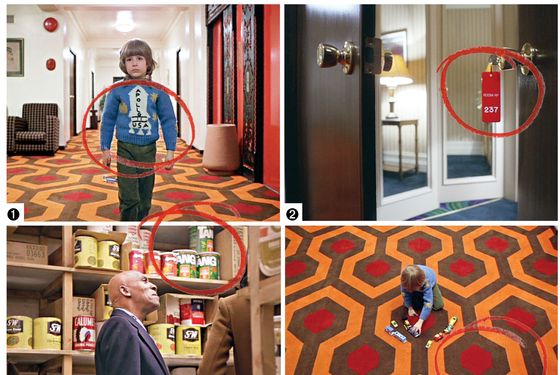
This picture circles some of the topics of conspiracy mentioned in the documentary such as Danny's Apollo 11 sweater and the cans of Calumet baking powder displaying a Native American man in a headdress.
Subscribe to:
Comments (Atom)